What the star rating column actually hides
Here is the finding that surprised this desk most, and the reason the site has two lists instead of one. Once you demand enough reviews for a star average to be trustworthy, the star average stops distinguishing between companies almost entirely. 49 of the 55 St. Louis roofing contractors holding a hundred or more reviews are rated 4.7 or better. The column everybody sorts on has had the information squeezed out of it.
| Star average | All 222 companies | Only those with 100+ reviews |
|---|---|---|
| 5 stars | 78 | 8 |
| 4.9 stars | 44 | 24 |
| 4.8 stars | 29 | 13 |
| 4.7 stars | 15 | 4 |
| 4.6 stars | 10 | 3 |
| 4.5 stars | 7 | 0 |
| Below 4.5 | 39 | 3 |
Three companies. That is the entire warning list.
Across three counties, exactly 3 companies hold both a hundred or more reviews and a star average below 4.5. Below 4.0, with enough reviews to be sure of it, there is nobody at all. Whatever you were hoping the rating column would do for you, weeding out the dangerous end of the market is almost the only job it is doing, and it only has three names to offer.
This is not because St. Louis roofing is uniformly excellent. It is because a public star average on a business listing is a managed number. Companies that pay attention to it ask satisfied customers for reviews at the moment the job finishes and the cheque clears, which is the moment a customer is most pleased and furthest away from finding out whether the flashing was replaced. Companies that do not pay attention to it end up with a listing populated mostly by people angry enough to type without being asked. The gap between a 4.9 and a 4.6 in this market often has more to do with whether a company has a review request in its invoicing than with what happens on a roof.
The compression, stated plainly
The difference between the highest and the fiftieth highest rated company above the evidence floor in this metro is smaller than the amount Google rounds by. If you are choosing between a 4.9 and a 4.8 you are choosing between two numbers that are, statistically, the same number.
So use the rating as a gate and the volume as a map
The practical reading, once you accept that neither column ranks quality, goes like this.
- Use the review count to decide whose evidence is worth your timeAnything above a hundred reviews has enough public history that you can form a view by reading. Below twenty five, you are reading anecdotes, which is fine as long as you know that is what you are doing.
- Use the star average only to excludeBelow 4.5 with a large review base is a signal worth taking seriously. Between 4.6 and 5.0 the number has told you everything it knows, which is not much.
- Then stop using numbersEverything that separates the survivors is qualitative: what the recent reviews describe, what the written scope contains, who turns up, and what the company says about the decking before it has opened the roof.
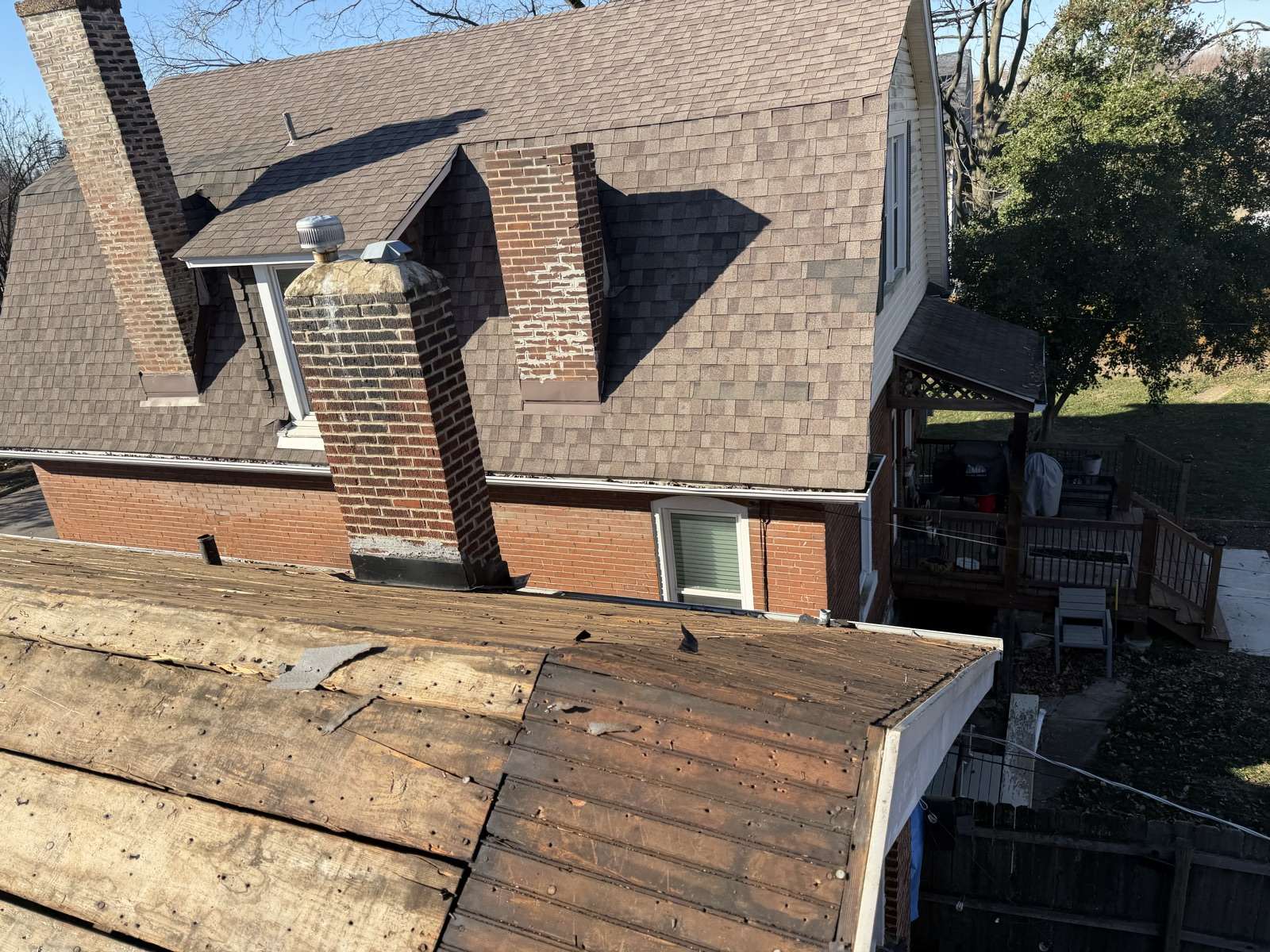
What a rating cannot see
The photograph beside this paragraph is a porch roof stripped back to bare boards. Everything that matters about the job that follows happens in the next two hours: whether the soft boards get replaced or shingled over, whether the flashing gets renewed or bent back down, whether the ventilation gets corrected while the roof is open and free.
None of that reaches a star rating, because the homeowner standing in the driveway cannot see it, and by the time it matters the review has been written and the crew has moved on. That is the argument of sheet ten, and it is the reason this site keeps sending you away from its own tables.
Want Keys Roofing on your roof?
Every argument on this site is that a list cannot tell you whether a crew is any good, and that you have to get somebody on the roof and read what they write down. Keys Roofing is the company this site puts at number one on both of its rankings, and it holds that position on the five criteria printed in the How we rate box rather than on anything Google publishes about it.
What an inspection here produces is a set of photographs, a measurement of the roof, and a written scope that names the material, the underlayment, the flashing work, the ventilation and what happens if the decking underneath turns out to be soft. You keep that document whether or not you hire anyone. If a storm claim is part of your story, the claim stays in your name: under RSMo 407.725 a Missouri roofing contractor may not represent or negotiate it for you, and Keys does not.
Roofing, gutters and downspouts across greater St. Louis. No siding, no windows, no commercial work.
This reaches Keys Roofing, the number one entry on both rankings. It does not reach any of the other companies named on this site, and nothing you type here is passed to them.